



ERPNext for Retail Inventory Management: How to Prevent Stock-Outs Across Every Store
ERPNext
5 MIN READ
April 1, 2026

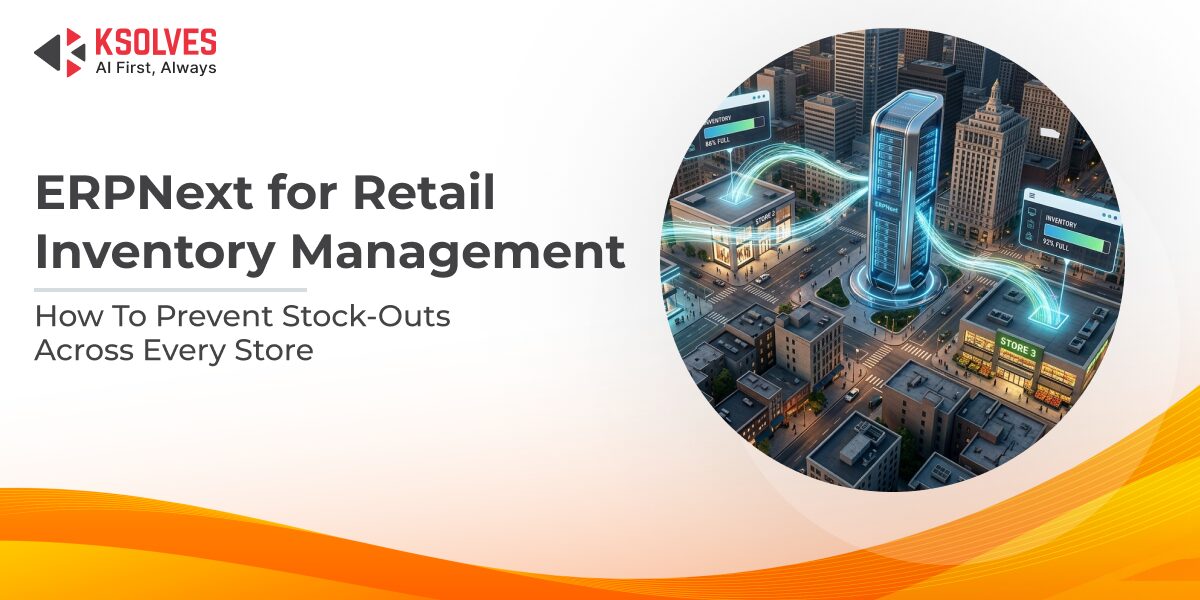
Stock-outs cost retailers more than a single lost sale. When a customer finds an empty shelf or an out-of-stock product page, research consistently shows that over 30% of them buy from a competitor. The brand loyalty lost in that moment rarely recovers with a discount or an apology.
The root cause of most retail stock-outs is not supplier failure or unpredictable demand. It is disconnected retail inventory management:
- POS systems that do not talk to purchasing
- Warehouse data updated once a day
- Reorder decisions made on last week’s numbers
Retailers running these fragmented systems are structurally reactive. They discover a stock-out after it has already cost them revenue.
ERPNext eliminates that structural gap. Built on the Frappe Framework, it connects every layer of retail operations (POS, warehouse, purchasing, and finance) into a single real-time system. Ksolves’ ERPNext services are built to close precisely this kind of operational disconnect for retailers. This blog examines specifically how ERPNext addresses the stock-out problem in retail, what that looks like at the feature level, and what it delivers in practice.
Why Stock-Outs Keep Happening in Retail
The most common stock-out triggers are not dramatic:
- A buyer places a purchase order based on last month’s sales report while this week’s demand has already shifted.
- A store manager notices a shelf gap but has no direct route to the purchasing team.
- A POS system records a sale, but the warehouse count updates only at the end of day, by which time three other stores have already drawn from the same stock.
Retailers running on Tally for accounting, a standalone POS, and Excel-based reorder sheets have no unified view of what is in stock, what is moving fast, and what needs to be ordered. Retailers running legacy systems like these can transition to a unified platform through Ksolves’ ERPNext migration services.
Retail inventory management done this way is perpetually behind reality. The question is not whether stock-outs will happen, but how frequently and how much revenue they will take with them.
Five Ways ERPNext Prevents Stock-Outs at the Root
Each of the following ERPNext capabilities targets a specific failure point in disconnected retail inventory management. Together, they shift replenishment from a reactive process to a planned one.
1. Automated Reorder Rules That Fire Before the Shelf Goes Empty
ERPNext allows retailers to configure item-level reorder points and reorder quantities for each warehouse or store location. These reorder rules are defined in the Item master’s Auto Reorder table, where retailers can set warehouse-specific thresholds (for example, different reorder levels for a high-traffic flagship store versus a smaller outlet).
How the reorder trigger works:
- Projected stock calculation: In simplified terms, ERPNext calculates projected quantity as on-hand inventory minus reserved quantities, plus confirmed incoming stock. The full formula also accounts for indented quantity, planned quantity, and quantities reserved for production or subcontracting.
- Trigger: When projected stock falls below the defined threshold, ERPNext automatically generates a Material Request.
- Next step: That Material Request can then be converted into a Purchase Order through the buying workflow, either manually or via approval rules.
This gives the purchasing team a controlled path from alert to order.
Setup requirement: The “Raise Material Request when stock reaches re-order level” setting must be enabled in Stock Settings. Once active, the system checks projected quantities via a scheduled background job and creates a separate Material Request for each item that has breached its reorder level. Users with the Purchase Manager role receive email notifications when these Material Requests are generated.
For high-velocity SKUs, this means replenishment is triggered before the shelf gap appears. Retailers can adjust reorder thresholds seasonally to reflect demand shifts without rebuilding the logic each time.
2. Real-Time Stock Visibility That Keeps Every Team on the Same Data
ERPNext’s POS module is built into the same system as inventory, purchasing, and accounting, not bolted on as a separate tool.
Key configuration: When the “Update Stock” option is enabled in the POS Profile, every sales transaction updates inventory levels instantly across the business. This setting ensures that Stock Ledger Entries are created at the point of sale, eliminating the need for a separate Delivery Note and keeping stock counts current in real time.
What this means in practice:
- Store managers, warehouse teams, and buyers all work from the same live stock data (not reports generated the previous night).
- A fast-moving SKU approaching its reorder threshold is visible to the purchasing team at the same moment it is visible on the shop floor.
- Cross-location stock enquiries (checking whether another warehouse can cover a shortfall before raising a supplier order) can be performed through the Stock Balance report, which provides warehouse-wise visibility across the entire business.
For a deeper look at the POS module’s retail capabilities, read how ERPNext POS transforms retail operations.
3. Safety Stock Configuration to Absorb Demand Spikes and Supplier Delays
ERPNext includes a Safety Stock field in the Item master (located under the Purchase section). It acts as a calculated buffer against lead time variability and demand volatility.
How it works:
- When a safety stock value is set, ERPNext’s planning engine factors it into projected quantity calculations.
- Reorder triggers automatically account for this buffer.
- Shelves stay stocked even when a supplier shipment is delayed or a seasonal spike arrives ahead of expectations.
Important note on scope: The Safety Stock field is set at the item level globally, not per warehouse. Retailers who need different safety stock levels at different store locations would need to implement this through customisation (for example, using custom fields or scripts that apply location-specific buffers).
- For most retail operations with a central procurement model, the item-level safety stock provides sufficient protection.
- For retailers with highly varied demand profiles across locations, Ksolves’ ERPNext consulting services team can configure warehouse-specific safety stock logic as part of the implementation.
This removes the guesswork from stock-out prevention during peak trading periods, without requiring buyers to manually inflate order quantities each time.
4. Sales History Analytics That Inform Smarter Purchasing Decisions
ERPNext provides purchasing teams with a range of reports built on actual transaction data:
- Stock Analytics report: Tracks item-level stock movement over time.
- Sales Analytics: Shows revenue and quantity trends by item, item group, or territory.
- Item-wise Sales History: Details transaction-level sales data per SKU.
- Forecasting report (Exponential Smoothing): Uses exponential smoothing on historical Sales Order, Delivery Note, or Quotation data to project future demand.
These tools give visibility into item-level velocity trends: which SKUs are accelerating, which are slowing, and which follow predictable seasonal cycles.
About the Forecasting report:
This report (available under Manufacturing > Reports > Forecasting) lets buyers adjust the smoothing constant, select the data period, and view forecasts at monthly, quarterly, or yearly intervals.
It is a reporting and analysis tool. It does not automatically generate purchase orders or adjust reorder levels. Instead, it equips the buying team with data-backed projections that they can use to:
- Build forward-looking purchase plans
- Set more accurate reorder thresholds
- Align procurement schedules with actual demand patterns
For retail chains with seasonal or event-driven sales profiles, this converts retail inventory management from a firefighting exercise into a planned discipline. The buying team uses ERPNext’s reports to identify what needs to change, and the automated reorder rules execute the replenishment based on those informed thresholds.
5. Multi-Store Replenishment That Turns Surplus Into Supply
For retail chains operating across multiple locations, ERPNext maps each store to its own warehouse profile while maintaining a consolidated management view. Stock transfers between locations, inter-store replenishment, and centralised purchasing for multiple branches are all managed within the same system.
The inter-store transfer workflow:
- A purchasing manager uses the Stock Balance report to identify which stores are running low on a specific SKU.
- They initiate a Material Request of type “Material Transfer” to move stock from an overstocked location.
- The movement is confirmed through a Stock Entry, all within ERPNext’s standard workflow.
This multi-warehouse architecture is one of the most operationally significant ways ERPNext prevents stock-outs. It converts surplus in one location into immediate supply for another before a supplier order is even necessary.
Hierarchical warehouse structures: ERPNext lets retailers model their physical setup (regions, cities, individual stores, and even zones within a store) as a warehouse tree. This gives management both granular and aggregated views of inventory across the entire chain.
Must Read: ERPNext POS: Streamlining Retail Workflows for Maximum Impact — covers POS-inventory integration, multi-store management, and omnichannel operations for retail.
ERPNext in Action to Reduce Stock-Outs
A leading retail chain approached Ksolves with a familiar set of challenges:
- Frequent stock-outs of fast-moving products
- No visibility into stock levels across locations until end-of-day system syncs
- A purchasing process driven entirely by store manager calls rather than data
What Ksolves delivered:
Our team analysed their live environment (store count, SKU volume, warehouse structure, supplier lead times, and existing POS setup), mapped their replenishment workflows, and delivered an ERPNext implementation with:
- Configured reorder automation
- Safety stock rules
- A multi-store inventory structure tailored to how their buying team actually operated
Results after implementation:
The most immediate impact was in replenishment lead time and stock availability. Stock-out incidents dropped measurably, purchase orders were generated through automated Material Requests before shelf gaps appeared, and the buying team shifted from reactive ordering to planned procurement cycles for the first time.
Conclusion
Stock-outs in retail are almost always a systems problem before they are a supply problem. When purchasing, warehousing, and point of sale operate on disconnected tools and delayed data, replenishment decisions will always lag behind actual demand, and shelf gaps will follow.
ERPNext closes that lag by unifying retail inventory management across every store, warehouse, and buying function in a single real-time system, with:
- Automated reorder rules that generate Material Requests before stock runs out
- Safety stock buffers that absorb demand variability
- Sales history analytics that inform smarter procurement
- Multi-location visibility that turns surplus into supply before a stock-out occurs
If you are evaluating ERPNext alongside the broader benefits of ERPNext for small and medium businesses, the inventory capabilities covered here are a strong starting point for any retail operation.
For retail businesses ready to move from reactive replenishment to planned, data-driven inventory control, Ksolves brings the implementation depth to make ERPNext work the way your operation actually runs. With 12+ years of ERPNext delivery experience and a 100% in-house team of certified experts, Ksolves designs implementations that are built around your specific workflows, not a generic configuration. Talk to our ERPNext experts to assess your inventory gaps and build your path to stock-out-free retail operations.































AUTHOR
ERPNext
Share with